
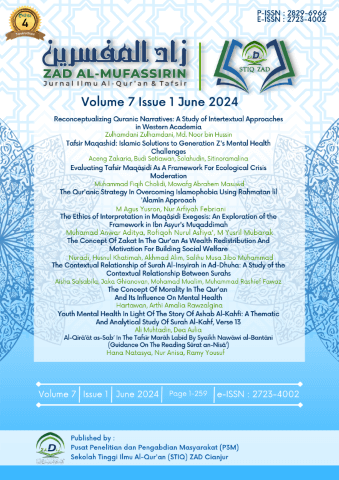
Evaluating Tafsir Maqāṣidī As A Framework For Ecological Crisis Moderation
Article Sidebar
Main Article Content
Abstract
This study aims to re-evaluate the offer of maqāṣidī interpretation in resolving the ecological crisis caused by the anthropocentric paradigm. This study uses a qualitative method to analyze the philosophy and interpretation products of maqāṣidī tafsir through primary sources such as the works of figures who first formulated maqāṣid of the Qur'an as the philosophy of maqāṣidī tafsir and applied it in interpretation products; among them are Rashid Rida and Ṭāhir Ibn 'Āshūr. Based on this evidence, the findings reveal that there is inconsistency in maqāṣidī interpretation in mediating the contestation between theocentric and anthropocentric paradigms, therefore, it can be said that maqāṣidī interpretation is more adapted to the modern context and its needs without a clear frame of reference, rather than referring to God's purpose, although the word maqāṣid is synonymous with God's purpose. As a result, maqāṣidī interpretation does not place meaning in the midst of the contestation of the two paradigms but prefers one of them accordingly fit to the context.
Article Details

This work is licensed under a Creative Commons Attribution-ShareAlike 4.0 International License.
You are free to:
- Share — copy and redistribute the material in any medium or format for any purpose, even commercially.
- Adapt — remix, transform, and build upon the material for any purpose, even commercially.
- The licensor cannot revoke these freedoms as long as you follow the license terms.
Under the following terms:
- Attribution — You must give appropriate credit , provide a link to the license, and indicate if changes were made . You may do so in any reasonable manner, but not in any way that suggests the licensor endorses you or your use.
- ShareAlike — If you remix, transform, or build upon the material, you must distribute your contributions under the same license as the original.
- No additional restrictions — You may not apply legal terms or technological measures that legally restrict others from doing anything the license permits.
Notices:
You do not have to comply with the license for elements of the material in the public domain or where your use is permitted by an applicable exception or limitation .
No warranties are given. The license may not give you all of the permissions necessary for your intended use. For example, other rights such as publicity, privacy, or moral rights may limit how you use the material.
References
Ahmad, Siddig, Ahmad Sunawari Long, Zaizul Ab. Rahman, Muhammad Taufiq, and Hüseyin Elmhemit. “Mafhūmu Fiqhi Al-Marātib Wa Fiqhi al-Awlawiyyāt Fī Maqāṣidi al-Qurʾān: Dirāsah Taṭbīqiyyah Fī Malaysia.” AL-IHKAM: Jurnal Hukum & Pranata Sosial 19, no. 1 (June 30, 2024): 271–302. https://doi.org/10.19105/al-lhkam.v19i1.8917.
Al-Biqa’i, Abu Bakar. Naẓmu Ad-Durar Fī Tanāsubi Al-Āyāt Wa As-Suwar. Vol. 1. Kairo: Darul Kutub al-Islamiyyah, n.d.
Al-Manẓūr, Jamāluddīn Ibn. Lisānu Al-'Arab. Vol. 4. Beirut: Dār S}ādir, 1414.
Ar-Raisuni, Aḥmad. Naẓariyyatu Al-Maqāṣid 'inda al-Imām Asy-Syāṭibī. Virginia: Al-Ma’hād Al-'Ālamī Li al-Fikr Al-Islāmī, 1995.
Aṭ-Ṭabarī, Abū Ja'far Muhammad bin Jarīr. Jāmi'u al-Bayān 'an Ta`wīl Āy Al-Qur`ān. Makkah: Dār at-Tarbiyah wa at-Turāṡ, 2010.
Aṭ-Ṭūsī, Abū Ḥāmid Al-Gazalī. Jawāhir Al-Qur`ān. Beirut: Dar Ihya Al-Ulum, 1986.
Auda, Jasser. Maqasid Al-Shariah as Philosophy of Islamic Law: A Systems Approach. Edited by Jasser Auda. London: The International Inst. of Islamic Thought, 2008.
Auda, Jasser, Shiraz Khan, and A. S. Al-Shaikh-Ali. Maqāṣid Al-Sharīʻah: A Beginner’s Guide. Occasional Papers Series 14. London: International Institute of Islamic Thought, 2008.
Azizy, J., Sihabussalam Sihabussalam, Dasrizal Dasrizal, and Asmawi Asmawi. “The Term ‘Adl in the Qur’an Perspective of Tafsir Maqāṣidī Ibn ‘Āsyūr,” 61–65. London: Routledge, 2024.
Bargasy, Abdul Latif. Maqāṣid Suwar Al-Qur`ān Al-Karīm. Maroko: Ibnu Thufail University Press, 2022.
Cholidi, Muhammad Fiqih. “Pembacaan Rekontekstual Surah At-Taubah [9]: 123 Dan Aplikasinya Dalam Hubungan Beragama Dalam Negara (Pendekatan Tafsir Maqāșidi)” 15, no. 2 (2022).
De Jonge, Eccy. “An Alternative To Anthropocentrism: Deep Ecology And The Metaphysical Turn.” In Anthropocentrism, edited by Rob Boddice, 307–20. BRILL, 2011. https://doi.org/10.1163/ej.9789004187948.i-348.73.
Dozan, Wely, and Arif Sugitanata. “Hermeneutika Versus Maqashid (Tafsir Maqashidi) Sebagai Gerakan Membumikan Penafsiran Al-Qur`an” 10, no. 1 (June 2021): 1–21.
Droz, L. “Anthropocentrism as the Scapegoat of the Environmental Crisis: A Review.” Ethics in Science and Environmental Politics 22 (May 5, 2022): 25–49. https://doi.org/10.3354/esep00200.
Fikriyati, Ulya. “Maqāṣid Al-Qur`ān Dan Deradikalisasi Penafsiran Dalam Konteks Keindonesiaan.” ISLAMICA: Jurnal Studi Keislaman 9, no. 1 (September 2014).
Firdaus, Muhammad Yoga. “Konservasi Lingkungan Pada Teori Intertekstual Julia Kristeva: Analisis Dalam Tafsir al-Taḥrīr Wa al-Tanwīr Dengan Pendekatan Tafsir Maqāṣidī.” UIN Sunan Gunung Djati, 2023.
Fitriono, Eko Nani, M Ferry Muttaqin, and Rasmi Nur Hidayah. “Kontribusi Tafsir Maqashidi Dalam Pengembangan Makna Teks Al- Quran: Telaah Ayat-Ayat Relasi Keluarga Dalam Tafsir Al –Azhar Karya Hamka.” Al-Mikraj: Jurnal Studi Islam dan Humaniora 4, no. 2 (2024).
Gribben, Jennifer, and Julie M Fagan. “Halting Climate Change Will Require a Cultural Shift toward Eco-Centrism,” n.d.
Hakim, Muhammad Naufal. “Maqâshidiyyah Integratif dan Prinsip Metodologi Teori Tafsîr Maqâshidî Abdul Mustaqim” 24, no. 2 (2023).
Hasbillah, Ahmad Ubaydi. “Min Al-Ḥarbi Ilā al-Iṣlaḥ Wa al-Salam: Tafsiru Āyāti Āl-Jihād ʿala Ḍawʾi Maqaṣidihā.” Jurnal Studi Ilmu-Ilmu Al-Qur’an Dan Hadis 23, no. 1 (January 31, 2022): 145–72. https://doi.org/10.14421/qh.2022.2301-08.
Haswa, Maher, Man Baker, and Moath Alnaief. “Image of Women in Islam: Maqāsid Approach for Correct Interpretation.” Journal of Islamic Thought and Civilization 14, no. 1 (June 14, 2024): 1–16. https://doi.org/10.32350/jitc.141.01.
Hidayati, Tri Wahyu. “Tafsir Maqashidi as an Alternative Approach in Interpreting the Qur’an.” Journal of Islamic Studies and Humanities 5, no. 2 (n.d.).
Hossain, Faruque. “Anthropocentric Approach to the Environment: An Overview.” Journal of Social Science, n.d.
Ibn ’Asyur, Muhammad Thahir. Maqāsid Asy-Syarī’ah al-Islāmiyyah. Cairo: Dar al-Kutub Al-Misri, 2011.
———. Tafsīr At-Tahrīr Wa at-Tanwīr. Vol. 28. Tunis: Ad-Dar At-Tunisiyyah, 1984.
Ibrahim, Aji Muhammad, and Farah Aisya Bela. “Tafsir Maqashidi Prespektif Abdul Mustaqim.” JIQTA: Jurnal Ilmu Al-Qur’an dan Tafsir 2, no. 2 (December 29, 2023): 127–37. https://doi.org/10.36769/jiqta.v2i2.438.
Ibrahim, Syed Alaudeen Seyed, and Thameem Ushama. “Maqāṣid Al-Qur’ān: Exploring Higher Objectives and Intellectual Insights.” Al-Burhān Journal of Qurʾān and Sunnah Studies 8, no. 1 (2024).
Islam, Tazul. “Expansion Of Maqósid Thought Beyond Maqósid Al-Sharî‘ah: Maqósid Al-Qurón As A New Paradigm.” Hamdard Islamicus 45, no. 4 (2022).
———. “Ibn Ashur’s Views On Maqosid Al-Qur’an: An Analysis” 14, no. 2 (2018).
———. “Maqasid Al-Qur’an and Maqasid Al-Shari’ah: An Analytical Presentation.” Revelation and Science 3, no. 1 (n.d.): 2013.
Islam, Tazul, and Amina Khatun. “Objective-Based Exegesis of The Quran: A Conceptual Framework.” Quranica 7, no. 1 (2015).
Jaworski, Romuald. “Anthropocentric and Theocentric Spirituality as an Object of Psychological Research.” Journal for Perspectives of Economic Political and Social Integration 21, no. 1–2 (December 1, 2015): 135–54. https://doi.org/10.2478/pepsi-2015-0006.
Kolkailah, Naiyerah. “An Ethical Approach to Creating Gardens Inspired by Qurʾānic Narratives.” Journal of Islamic Ethics, November 16, 2023, 1–27. https://doi.org/10.1163/24685542-20230092.
Kusmana, Kusmana. “Epistemologi Tafsir Maqasidi.” MUTAWATIR 6, no. 2 (February 7, 2018): 206–31. https://doi.org/10.15642/mutawatir.2016.6.2.206-231.
Matsna Afwi Nadia and M. Riyan Hidayat. “Fiqh Lingkungan: Analisis atas QS. Ar-Rum’ [30]: 41 Perspektif Maqasidi.” At-Tahfidz: Jurnal Ilmu Al-Qur’an dan Tafsir 5, no. 1 (November 6, 2023): 34–48. https://doi.org/10.53649/at-tahfidz.v5i1.360.
Mingucci, Giulia. “The Place of Human Beings in the Natural Environment - Aristotle’s Philosophy of Biology and the Dominant Anthropocentric Reading of Genesis.” Journal of Ancient Philosophy 15, no. 2 (October 14, 2021): 210–25. https://doi.org/10.11606/issn.1981-9471.v15i2p210-225.
Mujib, Lalu Supriadi B., and Khairul Hamim. “Religious Freedom and Riddah through the Maqāṣidī Interpretation of Ibn ‘Āshūr.” HTS Teologiese Studies / Theological Studies 77, no. 4 (November 12, 2021). https://doi.org/10.4102/hts.v77i4.6928.
Mustaqim, Abdul. Argumentasi Keniscayaan Tafsir Maqashidi sebagai Basis Moderasi Islam (2019).
Ozdemir, Ibrahim. “Towards An Understanding of Environmental Ethics from a Qur’anic Perspective,” n.d.
Rahiem, Maila D.H. Religion, Education, Science and Technology towards a More Inclusive and Sustainable Future: Proceedings of the 5th International Colloquium on Interdisciplinary Islamic Studies (ICIIS 2022), Lombok, Indonesia, 19-20 October 2022. 1st ed. London: Routledge, 2024. https://doi.org/10.1201/9781003322054.
Rida, Muhammad Rasyid. Al-Waḥyu Al-Muḥammadī. Libanon: Dār al-Kutub al-‘Ilmiyyah, 2005.
Ridha, Muhammad Rasyid, and Muhammad Abduh. Tafsīr Al-Manār. 2nd ed. Vol. 2. Mesir: Dar al-Manar, 1947.
Rifqi, M. Ainur, and A. Halil Thahir. “Tafsir Maqasidi: Membangun Paradigma Tafsir Berbasis Mashlahah.” Millah 18, no. 2 (February 16, 2019): 335–56. https://doi.org/10.20885/millah.vol18.iss2.art7.
Rouiba, Driss. “Maqasidi Approach and Its Impact on the Science of Principles of Tafsir in the Thought of Imam Al-Shafi’ie.” Journal of Contemporary Maqasid Studies 2, no. 1 (January 15, 2023): 95–110. https://doi.org/10.52100/jcms.v2i1.97.
Seleem, Olaniyan Adeola, and Shamima Lasker. “Theocentrism Is Not Anthropocentric: An Enlightened Environmentalist Reading of the Holy Qur’an.” Bangladesh Journal of Bioethics 13, no. 1 (March 30, 2022): 61–70. https://doi.org/10.62865/bjbio.v13i1.34.
Shofa, Ida Kurnia. “The Comparation of Maqāṣīd Implementation’s Ibn ‘Aṣūr And Munāwir Sjadzali’s In Qs. 4: 11.” At-Tibyan 6, no. 1 (June 2021): 145–64.
Syamsir, Syamsir. “Maqashidi Tafsir: An Effort To Unveil The Intent And Purpose Of The Qur’an In Contemporary Context.” TAFASIR: Journal of Quranic Studies 2, no. 1 (June 28, 2024): 70–84. https://doi.org/10.62376/tafasir.v2i1.32.
Wathani, Syamsul. “Konfigurasi Nalar Tafsir Maqashidi.” Suhuf 9, no. 2 (Desember 2016): 293–320.
Wijaya, Aksin, and Shofiyullah Muzammil. “Maqāṣidi Tafsir: Uncovering and Presenting Maqāṣid Ilāhī-Qur’anī into Contemporary Context.” Al-Jami’ah: Journal of Islamic Studies 59, no. 2 (December 31, 2021): 449–78. https://doi.org/10.14421/ajis.2021.592.449-478.
Zaid, Wasfi ’Asyur Abu. Nahwu Tafsīr Maqāsidī Li Al-Qur’ān al-Karīm. Saudi: Dar Al-Waraqat, 2018.