
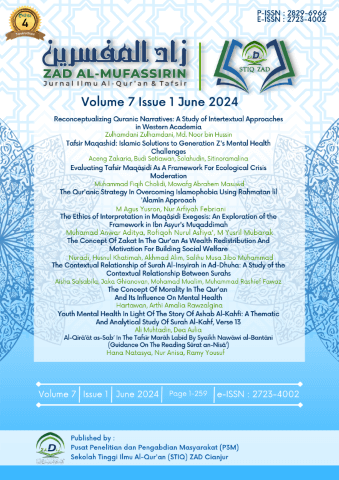
The Concept Of Zakat In The Qur'an As Wealth Redistribution And Motivation For Building Social Welfare
Article Sidebar
Main Article Content
Abstract
This study aims to analyze the concept of zakat in the Qur'an as an instrument of wealth redistribution and social welfare programs, and explore its role in reducing social inequality and poverty in Islamic society. This type of research is a qualitative approach with literature research. Data collection is carried out through literature review of various Qur'anic verses consisting of related zakat issues. The research results show that zakat plays an important role in maintaining economic balance by channeling wealth from the wealthy to the needy. In addition, zakat in the Qur'an serves as a comprehensive solution for poverty alleviation, while strengthening social solidarity, and creating a more inclusive and prosperous society. In terms of social welfare motivation, it is mentioned in several verses, such as supporting the collective welfare of Al-Hasyr verse 7, empowering vulnerable groups Ad-Dhuha verses 9-10, promising good rewards in the hereafter for those who care about the welfare of others Al-Baqarah verse 261, and Adz-Zariyat verse 19. Thus, the concept of zakat in the Qur'an is not only a religious obligation, but also a comprehensive framework for upholding social justice, reducing inequality, and promoting inclusive economic welfare.
Article Details

This work is licensed under a Creative Commons Attribution-ShareAlike 4.0 International License.
You are free to:
- Share — copy and redistribute the material in any medium or format for any purpose, even commercially.
- Adapt — remix, transform, and build upon the material for any purpose, even commercially.
- The licensor cannot revoke these freedoms as long as you follow the license terms.
Under the following terms:
- Attribution — You must give appropriate credit , provide a link to the license, and indicate if changes were made . You may do so in any reasonable manner, but not in any way that suggests the licensor endorses you or your use.
- ShareAlike — If you remix, transform, or build upon the material, you must distribute your contributions under the same license as the original.
- No additional restrictions — You may not apply legal terms or technological measures that legally restrict others from doing anything the license permits.
Notices:
You do not have to comply with the license for elements of the material in the public domain or where your use is permitted by an applicable exception or limitation .
No warranties are given. The license may not give you all of the permissions necessary for your intended use. For example, other rights such as publicity, privacy, or moral rights may limit how you use the material.
References
Adeniji, Lateef Akanb, and Adetunji. “Zakat: An Islamic Institution for Ameliorating Poverty among the Muslims.” Imperial Journal of Interdisciplinary Research 3, no. 1 (2016): 1490–92.
Ahmed Shaikh, Salman. “Capitalizing on Economic Function of the Institution of Zakāt in Modern Economy.” International Journal of Zakat 3, no. 4 (2018): 33–49. https://doi.org/10.37706/ijaz.v3i4.105.
Al-Banna, Mohammed Abdul Karim, and Ian Michael. “Zakat and Its Socio-Economic Merits: A Holistic View towards Eradication of Poverty.” In Islamic Perspectives on Marketing and Consumer Behavior: Planning, Implementation, and Control, 296–314, 2015. https://doi.org/10.4018/978-1-4666-8139-2.ch013.
Al-Mahalli, Jalaluddin, and Jalaluddin Al-Suyuti. Tafsir Al-Jalalain. Beirut: Dar al-Kutub al-Ilmiyyah, 2012.
Al-Qaradhawi, Yusuf. Fiqh Az-Zakah. Beirut: Mu’assasah ar-Risalah, 1973.
Al-Salih, Aysha N. “The Role of Zakat in Establishing Social Welfare and Economic Sustainability: The Case of Saudi Arabia.” International Journal of Financial Research 11, no. 6 (2020): 196–202. https://doi.org/10.5430/ijfr.v11n6p196.
Alghobaiwi, Talal Abdulhadi. “The Effectiveness of Proposed Computerized Program for Developing the Higher-Order Thinking Skills in Unit of Zakat in the Fiqh Curriculum among Prep School Pupils in the Kingdom of Saudi Arabia.” International Journal of Research and Education 41, no. 3 (2017): 49–74.
Alwi, Muhammad, Mikdar Rusdi, Achmad Abubakar, and M Ilham. “Al-Mustadh’afin: Reflection of the Qur’an on Social Inequalities.” FITRAH: Jurnal Kajian Ilmu-Ilmu Keislaman 8, no. 2 (2022): 327–44. https://doi.org/10.24952/fitrah.v8i2.5633.
Arif, Muhammad. “Zakat as a Mode of Poverty Alleviation.” International Journal of Economics & Management Sciences 06, no. 06 (2017): 1–6. https://doi.org/10.4172/2162-6359.1000473.
Ariyani, Nafiah. “Zakat as a Sustainable and Effective Strategy for Poverty Alleviation: From the Perspective of a Multi-Dimensional Analysis.” International Journal of Zakat 1, no. 1 (2016): 89–107. https://doi.org/10.37706/ijaz.v1i1.9.
Ashfahany, Afief El, Awalul Dini Nur Hidayah, Lukmanul Hakim, and Mohd Shahid Bin Mohd Noh. “How Zakat Affects Economic Growth In Three Islamic Countries.” Journal of Islamic Economic Laws 6, no. 1 (2023): 45–61. https://doi.org/10.23917/jisel.v6i1.21242.
Bediwi, Salam S. “Al-Zakat and Its Role in Social Solidarit -The Zakat Fund in The Endowments of Samarra as a Model.” Journal Islamic Sciences 1159, no. 12 (2021): 278–98. https://coisc.uosamarra.edu.iq/wp-content/uploads/2023/03/e4f8c55fb58deadb.pdf.
Beik, Irfan Syauqi, and Caesar Pratama. “Zakat Impact on Poverty and Welfare of Mustahik: A CIBEST Model Approach.” AFEBI Islamic Finance and Economic Review 1, no. 01 (2017): 1. https://doi.org/10.47312/aifer.v1i01.16.
Bouanani, Mejda, and Besma Belhadj. “Does Zakat Reduce Poverty? Evidence From Tunisia Using the Fuzzy Approach.” Metroeconomica 71, no. 4 (2020): 835–50. https://doi.org/doi: 10.1111/MECA.12304.
Burkhonov, Ilyoskhon Muhiddinovich. “‘Zakat’ Has Ensured Fairness and Balance in Society.” Theoretical & Applied Science 85, no. 05 (2020): 201–4. https://doi.org/doi: 10.15863/TAS.2020.05.85.41.
Darsono, Susilo Nur Aji Cokro, Mitha Raihana, Hafsah Fajar Jati, and Anisya Pachmi. “The Impact of Productive Zakat on the Income Inequality of Mustahiq in Yogyakarta.” Journal of Economics Research and Social Sciences 3, no. 1 (2019): 56–71. https://doi.org/10.18196/jerss.030107.
Furqani, Hafas, Ratna Mulyany, and Fahmi Yunus. “Zakat for Economic Empowerment (Analyzing the Models, Strategy and Implications of Zakat Productive Program in Baitul Mal Aceh and Baznas Indonesia).” Iqtishadia: Jurnal Kajian Ekonomi Dan Bisnis Islam 11, no. 2 (2018): 392–411. https://doi.org/10.21043/iqtishadia.v11i2.3973.
Ganiyev, Avazbek, and Sherzodjon Umaraliev. “The Role of Zakat In The Early Stages of The Islamic Civilisation.” EPRA International Journal of Multidisciplinary Research (IJMR) 6, no. 6 (2020): 441–44. https://doi.org/10.36713/epra2013.
Hakim, Lukman, and Ahmad Danu Syaputra. “Al-Qur’an Dan Pengentasan Kemiskinan.” Jurnal Ilmiah Ekonomi Islam 6, no. 3 (2020): 629–44. https://doi.org/10.29040/jiei.v6i3.1310.
Hoque, Nazamul. “Promoting Business Zakah as a Product of Islamic Finance to Fund Social Causes for Well-Being of the Underprivileged: Evidence from Bangladesh.” Journal of Islamic Marketing 14, no. 4 (2023): 966–87. https://doi.org/https://doi.org/10.1108/JIMA-10-2021-0337.
Jaffer, Muhammad Asif. “Can Zakat Charity Help Reduce Economic Inequality?” In International Conference of Zakat, 279–94, 2020. https://doi.org/10.37706/iconz.2020.202.
Jalili, Ahmad, Hasbi Umar, and Hermanto Harun. “Zakat Dan Keadilan Ekonomi Perspektif Islam, Kapitalisme, Dan Sosialisme.” Istidlal: Jurnal Ekonomi Dan Hukum Islam 6, no. 1 (2022): 1–10. https://doi.org/10.35316/istidlal.v6i1.388.
Jedidia, Khoutem Ben, and Khouloud Guerbouj. “Effects of Zakat on the Economic Growth in Selected Islamic Countries: Empirical Evidence.” International Journal of Development Issues 20, no. 1 (2020): 126–42. https://doi.org/doi: 10.1108/IJDI-05-2020-0100.
Kafabih, An’im, and Setyo Tri Wahyudi. “Zakat and Economic Development: Study in Three Muslim Countries in Southeast Asia.” Quantitative Economics Journal 9, no. 1 (2021): 1. https://doi.org/10.24114/qej.v9i1.23595.
Kailani, Najib, and Martin Slama. “Accelerating Islamic Charities in Indonesia: Zakat, Sedekah and the Immediacy of Social Media.” South East Asia Research 28, no. 1 (2020): 70–86. https://doi.org/10.1080/0967828X.2019.1691939.
Kathir, Ibn. Tafsir Al-Qur’an Al-’Azhim. Vol. 1-10. Beirut: Dar al-Kutub al-Ilmiyyah, 1999.
Kemenag RI. Al-Qur’an Dan Terjemahannya Edisi Penyempurnaan 2019. 1st ed. Lajnah Pentashihan Mushaf Al-Qur’an, 2019.
Kern, Florian G. “The Trials and Tribulations of Applied Triangulation: Weighing Different Data Sources.” Journal of Mixed Methods Research 12, no. 2 (2018): 1–35. https://doi.org/10.1177/1558689816651032.
Khatimah, Husnul, and Nuradi. “Pemberdayaan Dan Peningkatan Kemandirian Mustahiq Menjadi Muzakki.” Laa Maysir 7, no. 2 (2020): 140–55. https://doi.org/https://doi.org/10.24252/lamaisyir.v7i2.13303.
Khatimah, Husnul, and Nuradi Nuradi. “Pemberdayaan Mustahiq BAZNAS Kabupaten Sukabumi Melalui Program Bangkit Usaha Mikro Berbasis Masjid Desa Peradaban Zakat (BUMI DPZ).” Jurnal Ilmiah Ekonomi Islam 7, no. 1 (2021): 23–33. https://doi.org/10.29040/jiei.v7i1.1594.
Mahfuzha, Arfah, Cut Zakia Rizki, Diana Sapha, Fitriyani Fitriyani, Abd Jamal, and Weri Weri. “Is Zakat Important in Reducing Poverty?” In Advances in Social Science, Education and Humanities Research, 292:558–62, 2019. https://doi.org/10.2991/agc-18.2019.83.
Malik, Bilal Ahmad. “Philanthropy in Practice: Role of Zakat in the Realization of Justice and Economic Growth.” International Journal of Zakat 1, no. 1 (2016): 64–77.
Mariyanti, Tatik, Yuswar Zaenul Basri, and Jozi Jazuli. “The Basic Factors Driving The Intention To Pay Zakat.” APTISI Transactions on Management (ATM) 6, no. 1 (2022): 30–41. https://doi.org/10.33050/atm.v6i1.1692.
Marpaung, Arifin. “Zakat Regulation as a Reduction of Income Tax in Indonesia.” Budapest International Research and Critics Institute (BIRCI-Journal): Humanities and Social Sciences 3, no. 3 (2020): 2109–16. https://doi.org/10.33258/birci.v3i3.1143.
Masroom, Mohd Nasir bin, Siti Norlina bt Muhamad, and Siti Aisyah bt Panatik. “Peranan Zakat Dalam Merawat Jiwa (Zakah as a Soul Treatment).” UMRAN - International Journal of Islamic and Civilizational Studies 3, no. 1 (2017): 42–52.
Mohamad, M. Nusrate Aziz Osman Bin. “Islamic Social Business to Alleviate Poverty and Social Inequality.” International Journal of Social Economics 43, no. 6 (2016): 1–26. https://doi.org/http://dx.doi.org/10.1108/IJSE-06-2014-0129.
Muhafidin, Didin. “Implementation of the Zakat Policy as One of the Efforts to Reduce Poverty in Indonesia.” Al Qalam: Jurnal Ilmiah Keagamaan Dan Kemasyarakatan 17, no. 1 (2023): 243–54. https://doi.org/10.35931/aq.v17i1.1800.
Muhsin, Syamsiah, Achmad Abu Bakar, and Halimah Basri. “Konsep Kepemilikan Harta Sebagai Bagian Hak Asasi Ekonomi Perspektif Al-Qur’an.” Al-Azhar Journal of Islamic Economics 4, no. 2 (2022): 84–96. https://doi.org/doi: 10.37146/ajie.v4i2.170.
Noble, Helen, and Roberta Heale. “Triangulation in Research, with Examples.” Evidence-Based Nursing 22, no. 3 (2019): 67–68. https://doi.org/10.1136/ebnurs-2019-103145.
Nugroho, Wahyu, Syamsuri Syamsuri, Syamsuddin Arif, and Dzul Fadli. “Zakat Dan Jizyah Sebagai Pengendali Sistem Moneter: Sebuah Kajian Konseptual.” Islamic Economics Journal 5, no. 2 (2019): 163–80. https://doi.org/10.21111/iej.v5i2.3809.
Nuradi, Nurul Huda, and Husnul Khatimah. “Inovasi Wakaf Di Era Digital Dalam Mengoptimalkan Potensi Untuk Pembangunan Berkelanjutan Di Negeri Berkembang.” El-Mal: Jurnal Kajian Ekonomi & Bisnis Islam 5, no. 6 (2024): 3546–59. https://doi.org/DOI: https://doi.org/10.47467/elmal.v5i6.2773.
Nuradi, and Khatimah Husnul. “Analisis Strategi Pengumpulan Dana Zakat Pada BAZNAS Kabupaten Sukabumi.” Maqdis Jurnal Kajian Ekonomi Islam 5, no. 2 (2020): 178–93. https://doi.org/http://dx.doi.org/10.15548/maqdis.v5i2.531.
Oemar, Fahmi, Endri Endr, and Moh Taufan Nugroho. “The Potential of Paying Zakat on Income: Evidence From an Emerging Economy.” Corporate Governance and Organizational Behavior Review 7, no. 2 (2023): 128–37. https://doi.org/10.22495/cgobrv7i2p11.
Pratama, Siectio Dicko, and Rezha Nursina Yuni. “Reducing Poverty through Optimization of Zakat on Agricultural and Profession.” International Journal of Islamic Economics and Finance (IJIEF) 3, no. 2 (2020): 145–74. https://doi.org/10.18196/ijief.3237.
Putri, Anita Zonmi, and Aldo Yoga Pratama. “An Introduction To Fiqh Zakat: Definition, Normative Basis and Social Implication.” El -Hekam 6, no. 1 (2021): 155–74. https://doi.org/10.31958/jeh.v6i1.2423.
Rafiki, Ahmad. “The Impact of Zakat to the Economy, Organization, and Moral and Social.” In Impact of Zakat on Sustainable Economic Development, 139–58, 2020. https://doi.org/10.4018/978-1-7998-3452-6.ch010.
Ramadhini, Eveline. “Perceiving Utilization of Zakat through Economic Sociology Perspective.” In International Conference of Zakat, 232–42, 2019. https://doi.org/10.37706/iconz.2019.170.
Razak, Shaikh Hamzah Abdul. “Zakat and Waqf as Instrument of Islamic Wealth in Poverty Alleviation and Redistribution: Case of Malaysia.” International Journal of Sociology and Social Policy 40, no. 3–4 (2020): 249–66. https://doi.org/10.1108/IJSSP-11-2018-0208.
Said Nesturov. “Zakat as a Way to Overcome Poverty in Muslim Society.” Voprosy Teologii 4, no. 2 (2022): 233–40. https://doi.org/doi: 10.21638/spbu28.2022.204.
Saiti, Buerhan, Adama Dembele, and Mehmet Bulut. “The Global Cash Waqf: A Tool against Poverty in Muslim Countries.” Qualitative Research in Financial Markets 13, no. 3 (2021): 277–94. https://doi.org/10.1108/QRFM-05-2020-0085.
Salleh, Muhammad Syukri. “Contemporary Vision of Poverty and Islamic Strategy for Poverty Alleviation.” SAGE Open 7, no. 2 (2017): 1–8. https://doi.org/10.1177/2158244017697153.
Sarif, Suhaili, Nor Aini Ali, and Nor ‘Azzah Kamri. “Zakat for Generating Sustainable Income: An Emerging Mechanism of Productive Distribution.” Cogent Business and Management 11, no. 1 (2024): 1–14. https://doi.org/10.1080/23311975.2024.2312598.
Sarjan, Muhammad, Achmad Abubakar, and Halima Basri. “Pendayagunaan Zakat Dalam Upaya Penanggulangan Kemiskinan Perspektif Al-Qur’an.” Pepatudzu : Media Pendidikan Dan Sosial Kemasyarakatan 18, no. 1 (2022): 25–37. https://doi.org/10.35329/fkip.v18i1.2949.
Taqiyuddin, Hafidz, Mus’Idul Millah, and Hikmatul Luthfi. “Instruments of Property Ownership in Islam: The Study of Inheritance Law.” Journal of Islamic Thought and Civilization 13, no. 1 (2023): 157–71. https://doi.org/10.32350/jitc.131.11.
Tuan Mahmood, Tengku Mohd Azizuddin, Noormariana Mohd Din, Abdullah Al Mamun, and Mohamed Dahlan Ibrahim. “Issues And Challenges Of Zakat Institutions Achieving Maqasid Syariah In Malaysia.” AZKA International Journal of Zakat & Social Finance 2, no. 1 (2021): 119–37. https://doi.org/10.51377/azjaf.vol2no1.46.
Wæraas, Arild. “Thematic Analysis: Making Values Emerge from Texts.” Researching Values: Methodological Approaches for Understanding Values Work in Organisations and Leadership, 2022, 153–70. https://doi.org/10.1007/978-3-030-90769-3_9.
Wardhana, Rony, Elfira Badriyah, Martina Ningsih, Anik Mubiyatiningrum, and Heru Tjaraka. “Design of Productive Zakat Management Models with Social Business Insights Relating to Poverty Alleviation in Indonesia.” In CIFET 2019, 1–12, 2019. https://doi.org/10.4108/eai.21-9-2019.2293943.
Zaman, Asad. “An Islamic Approach to Inequality and Poverty.” Journal of King Abdulaziz University, Islamic Economics 31, no. 1 (2018): 69–92. https://doi.org/10.4197/Islec.31-1.4.